- Refining VC
- Posts
- The VC Marketing Market Map: How Leading VC Firms Think About Content Marketing
The VC Marketing Market Map: How Leading VC Firms Think About Content Marketing
How 50 VC firms think about content, distribution, and differentiation.

Laurie Owen
January 28, 2026
I’ve been working this week on a mega market mapping project with a firm.
It got me thinking that VCs love a market map but there are very few resources mapping VC firms, especially from a marketing perspective.
So I set a 30 minute timer, listed 50 firms and made one for VC marketing….
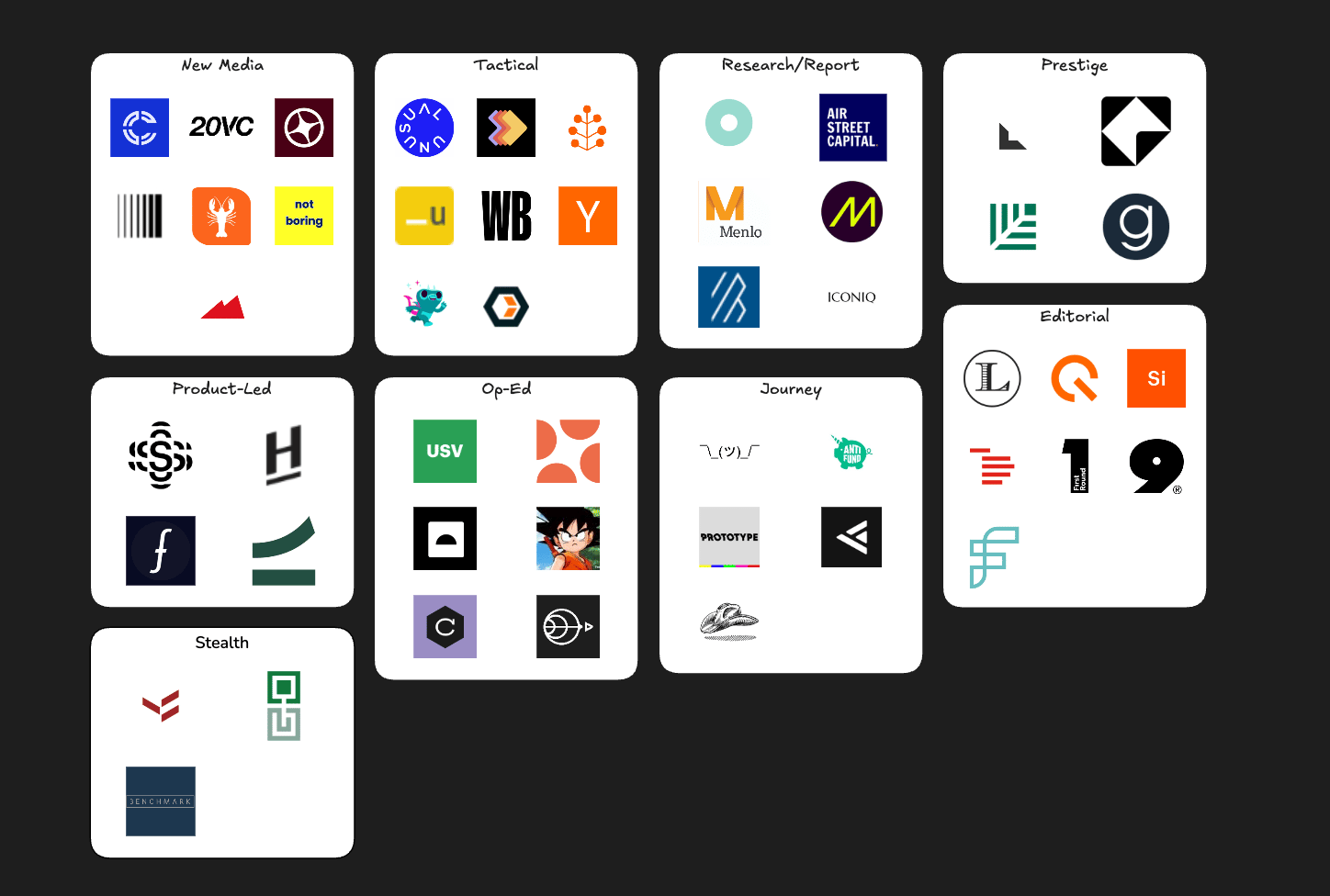
This is (obviously) a first draft. I used a tool called logomap (shout out to Pavel) to create the visual. If there's interest, I'll publish a complete stylised edition later this year.
A few notes before we get into it… I've tried to avoid explicitly solo GP brands. While some firms on here might have one GP presenting as themselves, I wanted to focus on firm-level approaches. There's a more in-depth piece about Partner led content here, and an upcoming piece on how funds can attribute growth from personal brands.
Obviously VC is fairly constrained in its media output compared to other industries. But there's a lot more breadth and creativity than just newsletters, LinkedIn or zoom podcasts. Hopefully this helps you see the various styles across the similar formats….
‘New Media’
This is really the modern multi-channel, multimedia approach. These firms act more media-savvy. They optimise for high frequency and for attention.
A16Z is the canonical example. They're doing everything. Content is a core strategy, a weapon of the firm. They're using this across the firm, across partners, across portfolio companies. And they're really doubling down (more) on this.
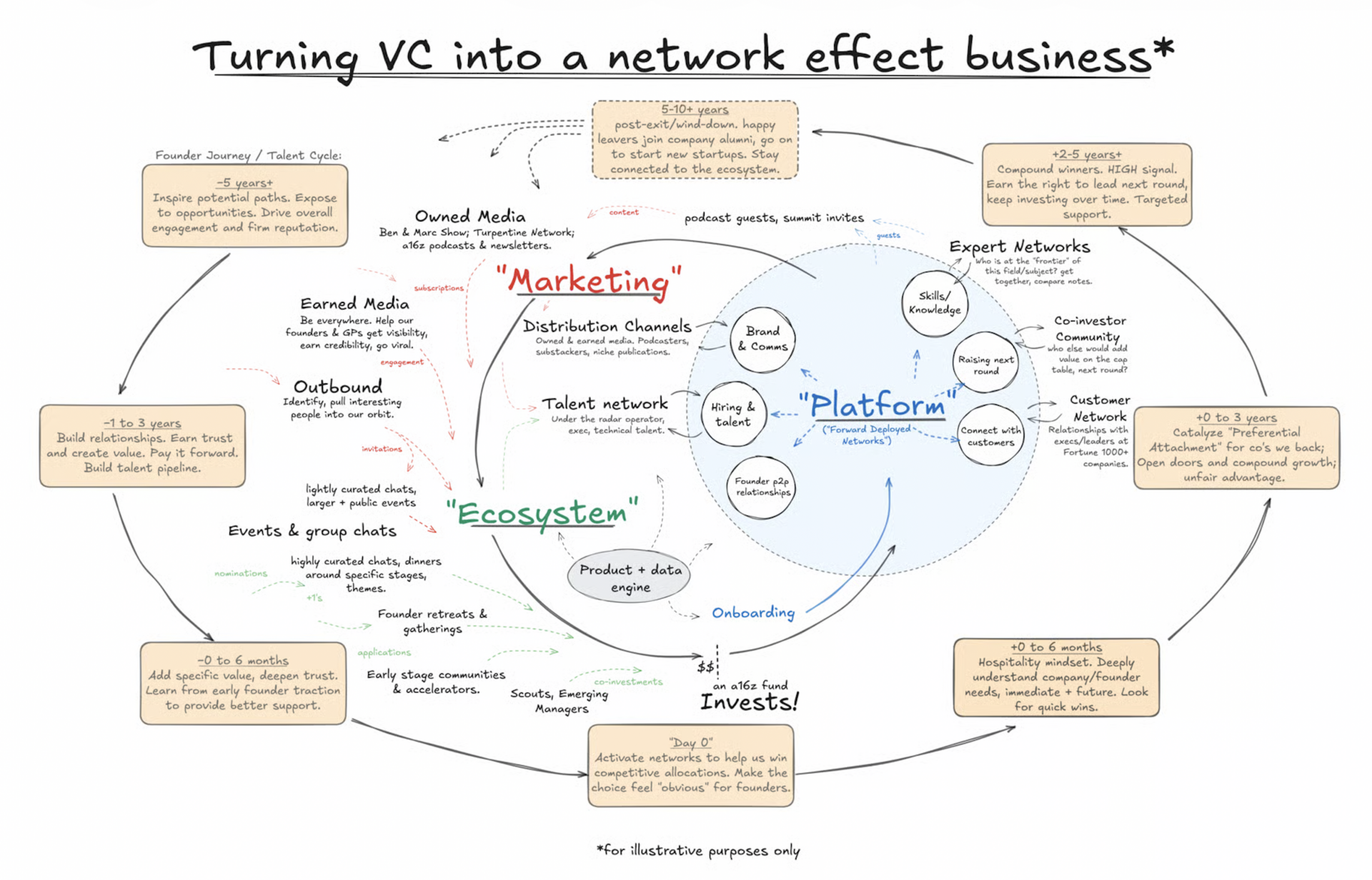
20VC does this differently - pushing Harry Stebbings as the individual brand but growing the firm through media. Provocation, volume, guest visibility. The guests aren't necessarily even 20VC portfolio companies. It's just the hope that having a big show will carry the name of the firm along with it. And it does. Hence their $500 million fund.
Smaller firms like Cambrian and Lobster are doing the upstart version… How do we compete with bigger players? Get more visibility on the GP's opinion, angle, thesis. They do this across multiple channels, which is why they're in this category.
Also included Sequel, which is a little more cinematic, definitely a slower approach, but still all-in on multimedia. Always trying to be video-first where they can be.
The other end of the spectrum is Packy McCormack's Not Boring. The fund exists because the media works, not the other way around. It's the OpEd approach - newsletter as a network - but the reason it's in this category is that the media came first.
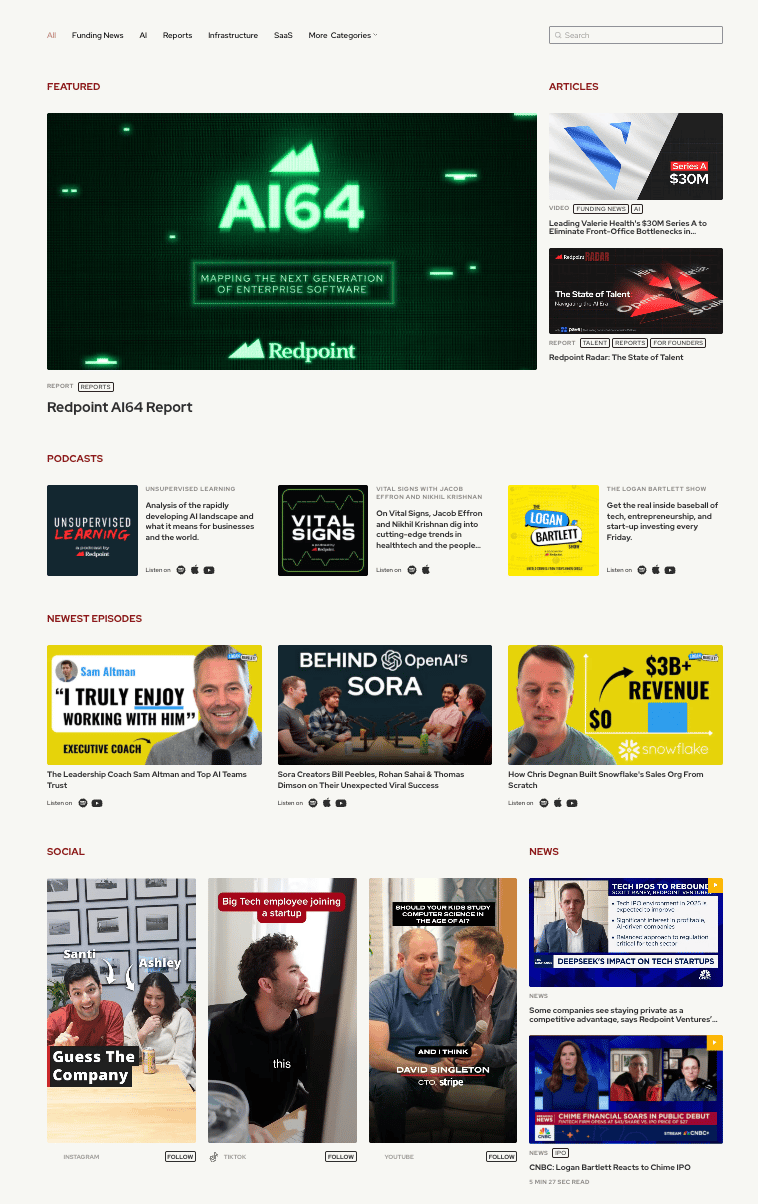
Redpoint is the reverse example. They're very social media native, a lot of short-form, a lot of humour. But this goes alongside their other plays in more traditional content.
What these firms understand: You're either growing continuous reach or you're invisible. Presence matters more than permanence in content.
The risk: Short-termism. Chasing engagement. Forgetting what you actually stand for.
Who should do this: Firms who can sustain volume without losing quality. Firms where a partner (or the whole team) is willing to be the face, and more niche firms should do this, Lobster for example literally talks about one thing (YC) - this mitigates one of the main risks.
Tactical
These firms publish fewer pieces, designed for founders to use immediately, and often pieces that have a lot of longevity. Focusing on the “how” for founders also makes these SEO / AEO gold mines.
Unusual Ventures' approach to product-market fit with their field guides - are second to none. Very impressive.
Y Combinator does the same thing. Historically they've done it in writing, but they're increasingly pushing toward video. With startup school focused on the earliest of founders. A much deeper dive on YC is here!
Also early focus is, Hustle Fund’s content strategy centres on building a high-trust, educational, and accessible brand that bridges the gap between founders and investors
At the other end of the spectrum, there's Heavybit. I included them because they're incredibly niche, very technical. They have a huge library of media about things that relate specifically to technical analysis for developers like their DevTool Digest weekly or developer podcast network.
Other examples: Boldstart, Airtree, Workbench. They're going after specific audiences and really focusing on the “guide”-based approach.
What these firms understand: Founders don't need more hot takes. They need solutions to real problems. Give them that, and they'll remember you when it's time to raise.
The risk: It's slow. It's resource-intensive. If you don't have distribution, nobody finds it.
Who should do this: Firms with deep domain expertise, or firms laser focused on a stage e.g. Pre-Seed. The more specific the advice the better!
Editorial
This is thinking about content as a library. It's a literary, narrative point of view.
Typically this is long-form, high-quality storytelling, but it blends a lot with the tactical approach too.
First Round Review is obviously the gold standard here. We did a huge breakdown of them last week - if you missed it, click here. But there are other firms doing hugely in-depth work. Index Ventures (we also did a breakdown of them) has incredible resources on scaling, compensation, winning in the USA. They're showing how their opinions are put into practice.
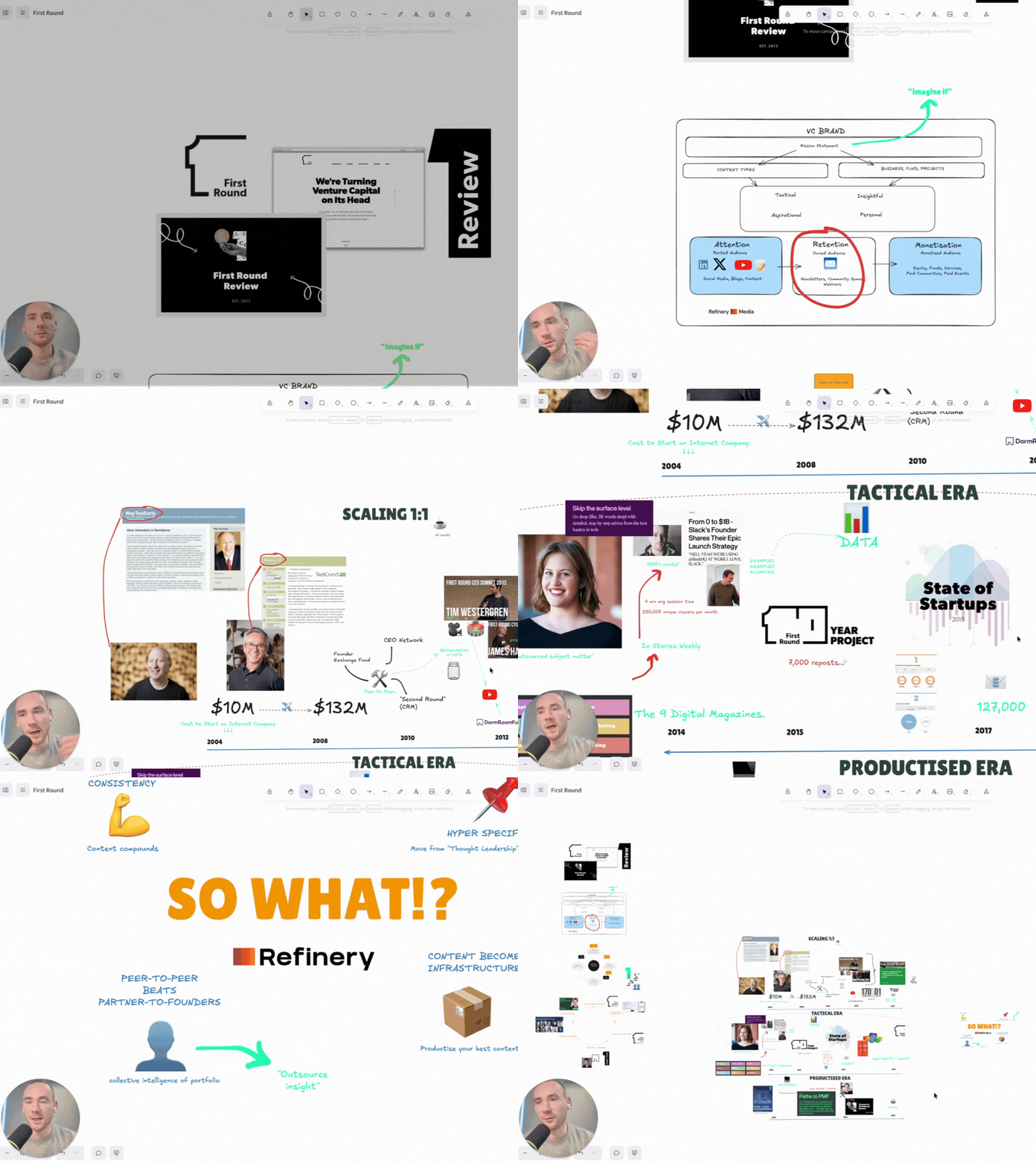
First Round practically invented this category. But Index, Point9, have followed up with high-fidelity, both physical and digital forms of content.
Lowercarbon inclusion might surprise people. I chose them because they've used editorial to drive a very specific mission-driven narrative. They have a unique style of doing this. Even though they're in a niche where you'd think they wouldn't have ten topics to talk about, they've figured out how to do it well within climate tech.
Foundation Capital and EQT are relatively similar. EQT is a much bigger firm. When you're on EQT ThinQ, it almost feels as complete as the FT. They create volume across a wide range of topics.
What these firms understand: Great writing compounds. A piece from 2018 still drives inbound in 2026 if it's good enough.
The risk: It's expensive. It requires writers who can actually write. And if your editorial voice isn't differentiated, you're just creating more noise.
Who should do this: More Generalist firms willing to invest in writers, editors, production. Firms who think in decades, not quarters.
Research Reports
This is probably the most cliche category for VC content. Data-led benchmarks. Industry standards. Firms establishing authority.
Atomico is a classic example. Bessemer with their State of the Cloud. These are the textbook reports that get cited everywhere. They're annual, they're points of reference.
But I think there are more interesting ways to do this.
Can firms think less like gods handing down research to people below and more about how they distribute these, how they break them up over time?
MMC is a good step in the right direction. They do reports on topics that feel accessible, and they have an ability to break those up in their distribution.
Menlo also does the blog-research combo crossover well and are very good at distributing individual bits across partners.
Airstreet I've included as a niche example. They were early to doing the State of AI stuff. They narrowed the scope of that research report, and by hammering that niche for a very long time - now that AI is no longer niche - they've risen to the top with it.
Ultimately, this comes back to things we talk about in VC all the time: How can you get unique data? I'd really like to see more firms produce data on themselves. How many deals are they seeing vs rejecting etc etc. More transparency = more trust.
What these firms understand: Owning the benchmark means owning the conversation.
The risk: Generic reports that say nothing new. Data for data's sake.
Who should do this: Firms with unique data access. Firms in a specific niche where they can own the definitive benchmark.
Op-Ed
“Thought leaders”, but I've tried to keep this to firms doing it at the firm-brand level.
I've included Foundry Group, USV, Theory Ventures - ofc, usually associated with particular GPs (Brad Feld, Fred Wilson, Tomasz Tunguz). But I wanted to show firms focusing on a long-term approach to content, not one-off blogs every other month but consistently putting their opinions out there.
Rex Woodbury has done a good job turning his Digital Native op-ed into a Daybreak asset. Whereas Collab Fund, and Slow have done this really well across multiple partners. All thinking in public and deciphering the long-term from the short-term conversation in the zeitgeist.
What these firms understand: Opinions create alignment. With founders, LPs, Co-investors… it’s good for everyone.
The risk: Being opinionated means being okay with being wrong sometimes.
Who should do this: Firms (or GPs) with strong convictions. Firms willing to be wrong in public.
Prestige
This is probably the least ‘practical’ category, but I'm trying to show how firms with a lot of legacy are taking on a media-first approach.
Sequoia is putting in a lot of effort to create very high-quality content across various streams. They have high-frequency podcasting and video, then lower-frequency, higher-impact thought leadership pieces in blog format. Because of their brand, this carries and travels incredibly well. They use this content to reinforce the idea of being the gold standard in venture + have a very good balance between macro thought leadership from partners and showcasing founder stories.
KP - you can see them starting to try and do the same thing. It's good to see them innovating in the podcast space (outside of just ‘Grit’ podcast) - recently launched Builders:
This one is interesting because they're highlighting operators within the companies they invest in, not just founders. This enables them to talk about tactical stuff while showcasing their portfolio and brand.
Lightspeed is also taking this very seriously, putting a lot of budget behind it. They brought in Josh Machiz from Redpoint and have a lot of different content styles. They recently did experiential, in-person event-style content at Davos “The Lighthouse”.
Lightspeed partner, Michael Mignano, does Out of Office where they've had people like Casey Neistat on, but they also showcase other VCs… This week featured Garry Tan. This goes alongside regular, consistent distribution of very high-quality Lightspeed content across reports and founder stories.
This is an interesting space to watch because you're starting to see how legacy firms are reacting to the market around them… mostly driven by a16z and YC. How can they, with bigger budgets and more time, take something that was quite protected, quite elite, and produce things that are original?
This will be the challenge for a lot of these firms moving forward. How do they not just do the same thing as each other? Where do they showcase their individual edge as larger firms through content? From a budgeting and legacy perspective, they have a huge leg-up over emerging managers. But they'll also struggle in some ways.
What to watch: For Smaller Firms…. It's worth watching for smaller firms to see where these bigger legacy firms are not doing well and where that creates opportunities. What are the things these firms are unwilling to do that smaller firms might be able to do?
The risk: Doing what everyone else does. Losing the edge in pursuit of polish.
Who should do this: Established firms trying to stay relevant in a media-first world. But only if they're willing to actually innovate, not just copy.
Product-Led
We've talked before about tools being the next frontier in VC marketing. These are the firms driving that.
NFX has tools like Signal, the library, Guild. They've done a lot of top-of-funnel work with these tools, but they also show how their network effects thesis comes to light through the tools themselves. The content is part of the product.
The tools are usually some embodiment of the thesis. Scale VP has SaaS benchmarking tools, which is related to how they think firms should go to market.
Headline has done a really good job with Conrad Chu. They have their Searchlight tool and other services. This is more value-add—tools they've included as part of their offering.
I've also included SignalFire here as well because they have a lot of internal tools. Beacon is their classic example. It's really entwined with what their brand is, what LPs think, what founders think, what other firms think when they think of SignalFire. The data platform comes first, content comes second. You can see how they're using the data from Beacon as a feeder for the content they create. This is marketing through utility.
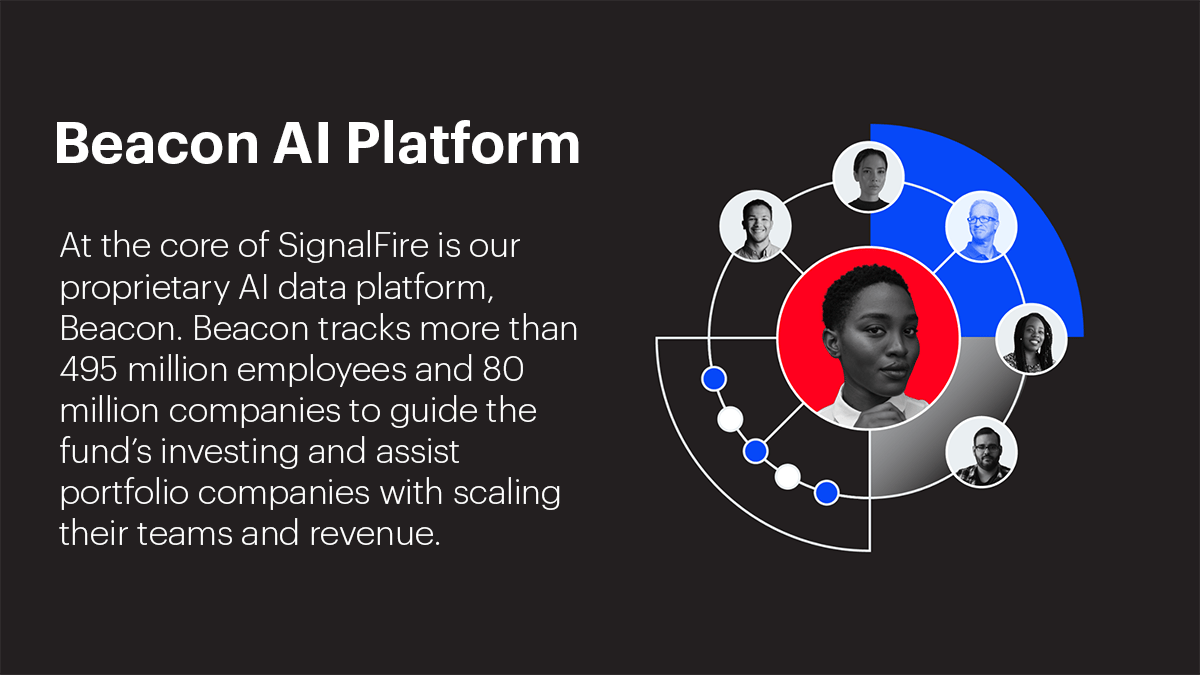
As VCs productise their processes (especially with AI), more will create tools for portfolio companies that double as marketing.
What these firms understand: Marketing through utility is more powerful than marketing through words.
The risk: Building a tool nobody uses. Or building a tool that's good but doesn't connect to the thesis.
Who should do this: Firms with proprietary data or processes. Firms willing to invest in product, not just content.
Journey
This is a broad category. It loosely relates to building in public, but it's also about showing the journey of what it's like to work with that firm. The journey of portfolio companies.
Founders Inc is the gold standard here. They showcase the startup-build lifestyle, the community, the content, the portfolio companies and the firm - it all blurs together.
Prototype Capital does a really good job at this. Andreas is definitely video-first in his communication. I think this will really start to compound for the firm over the next year as he launches Fund III. He does a lot of public thinking, and showcases his portfolio as deep tech is very visual. You see these videos as a progression of his thinking, a progression of the firm and portfolio companies, but also of macro narratives. This will work really well for them as a fund.
Anti Fund (Geoffrey Woo) has also been doing YouTube for years, now with Jake Paul and Logan Paul attached it will be interesting to see them double down on build in public.
But it doesn't have to be video.
I've also included Outlaw VC - building in public through Confluence, the media asset they own. They talk very openly about their thesis, about sourcing companies.
Shrug VC is also an interesting example.

They show their sourcing, the origination of the deal, the story of the portfolio companies - in case studies. They might show artifacts like the original email or pictures of when they first met the founders etc etc.
They do this in a very unpolished way - basically just Notion docs and screenshots—but that genuineness and openness is pretty unique. I'd love to see more firms do this.
There have been other firms who've done similar things in a much more polished way. Bessemer’s anti portfolio is a good example.
What these firms understand: Selling who you're becoming is more compelling than selling where you've been.
The risk: Over-sharing.
Who should do this: Emerging managers. Firms with visual theses (deep tech, hardware). Anyone willing to document progress for a long time.
Stealth
These firms are still relying on mystique and prestige. In some cases, partner brands.
Curious to see how these firms react. Benchmark obviously has an anti-brand approach to marketing. Thrive Capital has had this too, but they're increasingly coming out with more PR. You saw Thrive's Josh Kushner do a big feature with Colossus that was a viral hit in the summer.
We will see how these firms use other people’s channels a little more strategically - but content? Not so much…
The Three Question Takeaway
So which category should you be in?
1. What are you actually good at? What resources and individuals do you have in your firm? Don't force video if you can't tell stories. Don't force long-form if you can't write. Don't force memes if you're not funny. Play to your firm’s strengths.
2. Where is your audience? Are your founders reading 5,000-word essays or scrolling Twitter? Meet them where they are (more here).
3. What can you sustain? Content compounds. Pick the approach you can do consistently for 3+ years.
Laurie, Refinery Media
If you made it all the way through, thanks so much for reading! Several hundred VCs now open this every week. If it's helped you think differently about marketing, Venture, or storytelling, please send it to someone in your orbit.
If you enjoyed this, read more from our top posts: