- Refining VC
- Posts
- Not another VC Podcast
Not another VC Podcast
How to build a fund podcast that isn't the default - audience, questions, set, guest, production, disagreement.

Laurie Owen
August 21, 2026
The VC podcast has been memed into oblivion, and mostly fairly…
I have written before about why all VC content looks the same, and no format proves it harder than this one: 2 chairs, 1 founder, "so tell us about your journey."
To be candid about where this piece comes from. I am currently rebuilding 1 show I work on around a different format, while internally debating another podcast op for a client, has not worked the way we hoped.
Plus, a summer of flights means I have consumed more podcasts in 3 months than is medically advisable. Frustration + exposure has given me a few ideas.
Underneath the meme, the benefits are real.
Dialogue is the cheapest way for a GP to think out loud in public, it puts a face on the firm, showcases portfolio companies, prospects new founders/industries, and creates meetings that would not otherwise happen. Not to mention 1 hour of conversation chops into clips, blogs and tweets for a month.
The problem is that a podcast is a machine with levers, and many funds have never deliberately pulled any of them.
By the way, before we begin - if this all seems irrelevant you could always just be a guest on one instead…
Lever 1: Audience
The first lever for obvious reasons - every other lever is calibrated against it.
Be hyper specific. If your goal in all this is to have a “big” audeince, thats cool, but also.. why?
I have written about the technical blue ocean before in VC, but the nuances here run deeper… the difference between "founders" and "second-time founders” is the difference between competing generally with everyone and building a valuable audience.
This can be sliced a hundred different ways too, by industry, sector, stage, experience, age… or even by role in an org.
Lenny is the canonical case. Hyper niche focus on product managers, and built a deep and loyal audience. The show did not “find” an audience, more it “chose one”, and the audience built the show around itself… and well, inevitably deal flow followed.
Lever 2: Questions
Everyone knows the basics - do not ask what everyone else asks.
Better questions come from genuine POV and curiosity, which is also why subject matter podcasts (see lever 1) generally outperform.
Your audience, if properly dialled, can dictate the questions anyway.
You could take this further, and use you audience in the questions. Hormozi is running a version of this and is crushing it.
In mainstream, a move to clip farm and create audience consistency is actually asking the same questions of every guest. It sounds lazy and it is the opposite - fixed questions make guests comparable, and comparability is a format. It unlocks compilation episodes, comparison clips, and a reason to watch the next episode that has nothing to do with who is on it. Look at where clips come from in the sports and music podcast landscape - overwhelmingly from recurring thematic questions, because the question is the franchise and the guest becomes just a contestant.
Lever 3: Set
I am less convinced by this one, with exceptions worth understanding.
Paired with an epic guest, a set is a way to break out on the timeline.
Ti Morse / Relentless built a studio for a possible Elon episode, and the set alone did 2.5 million views before we even know if the podcast got recorded. The set was the content.
A set is also a way to package vibes, and I have written plenty about how much vibes matter in VC. If you are using the standard rent-a-podcast-room setup, the other levers had better be dialled.
I did not have "a-Lightspeed-podcast-dedicating-an-entire-episode-to-how-they-built-their-set" on my bingo card, but ironically, their whiteboard sessions with experts are significantly more interesting and more relevant to their true audience, kudos, and their metrics prove it too.

+1 that someone is doing this, I also wrote about “whiteboarding” months ago
But here is the caution before you spend the budget…. even on YouTube, the leading platform for podcasts, the data shows listeners split their time between active video viewing + background audio mode.
Overspending on production can be wasted spend, especially when more natural settings - outside, at events, on a walk - work as well or better.
Lever 4: Guests
If you want a "big" podcast, the guest is lever number 1, and nothing else comes close.


I promise you if you get Zuck or Satya on your show, people will listen. This is obvious.
But to be honest… with the audience and questions locked, the guest almost does not matter.
The simple iteration of a fund podcast is the default - an open-ended conversation with a founder about their company. But this gives the audience no reason to care that survives the guest's own network.
The less obvious one is get the companies people care about, through whoever is closest to them.
For example, Origins did a fanatastic episode on Thrive via Frank Guzzone, not Josh Kushner. Likewise, a Tesla episode does not need Musk, and one of the most insightful podcasts I’ve heard on Tesla/SpaceX came from ex-Tesla employee Jon McNeill (now at DVX ventures).
Then your questions (lever 2) takes over… how does Tesla do X, how does Thrive do Y… How Anthropic does Z.
Great case in point from South Park Commons and SPC alum, now Anthropic mots Thariq Shihipar above.
The guest's follower count is less relevant when the company is the draw, questions then become the format, and the content is likely much more original.
Lever 5: Production
The hour-long two-camera epic is a default, but not a law.
It is hard to look past the success of pseudo-podcasts in tech/vc/biz from the likes of Tara Keeney or James Dumoulin.
These walk-and-talks works partly because it is vertical - vertical video has a different commitment contract with the viewer. Nobody budgets an hour so the format promises brevity, and gets sampled by people who would never listen to an hour long epic.
I am not saying make a 2-minute show. I am saying the hour was never mandatory - the format is a choice you are allowed to make.
Andreas Klinger @Prototype - does a great job at compression “podcasts” into more digestable lengths, not to mention more dynamic format/editing.
This more dynamic production can also elevate the conversation. Many of Sourcery’s most successful clips or even full episodes come from outside of the 1:1 chair chats. Both Figure interviews below at ~3x the view count for an e.g.:
 |  |
Lever 6: Disagreement
I wrote last week about how venture lacks enemies, and the podcast feed is where you can watch the deficiency in real time.
In fact, one of the only TBPN clips I can remember is a clip from Sam Lessin (Slow) and Seth Rosenberg (Greylock) debating whether or not to invest in AI at all.
Consider how well presidential debates rate or how much of society's most-watched content is structured conflict. Then look at venture's podcast - a genre where everyone agrees with everyone, which guarantees nothing new gets said.
Disagreement is the cheapest newness machine available. A debate format, a red-team segment, a recurring guest whose job is to push back. You do not need hostility but push back and stakes make for interesting content.
What is an episode worth in 3 years?
The conceptual layer of all this got covered properly 2 weeks ago by Reggie James at General Catalyst, in a seriously good piece - Rules for Recorded Conversations.
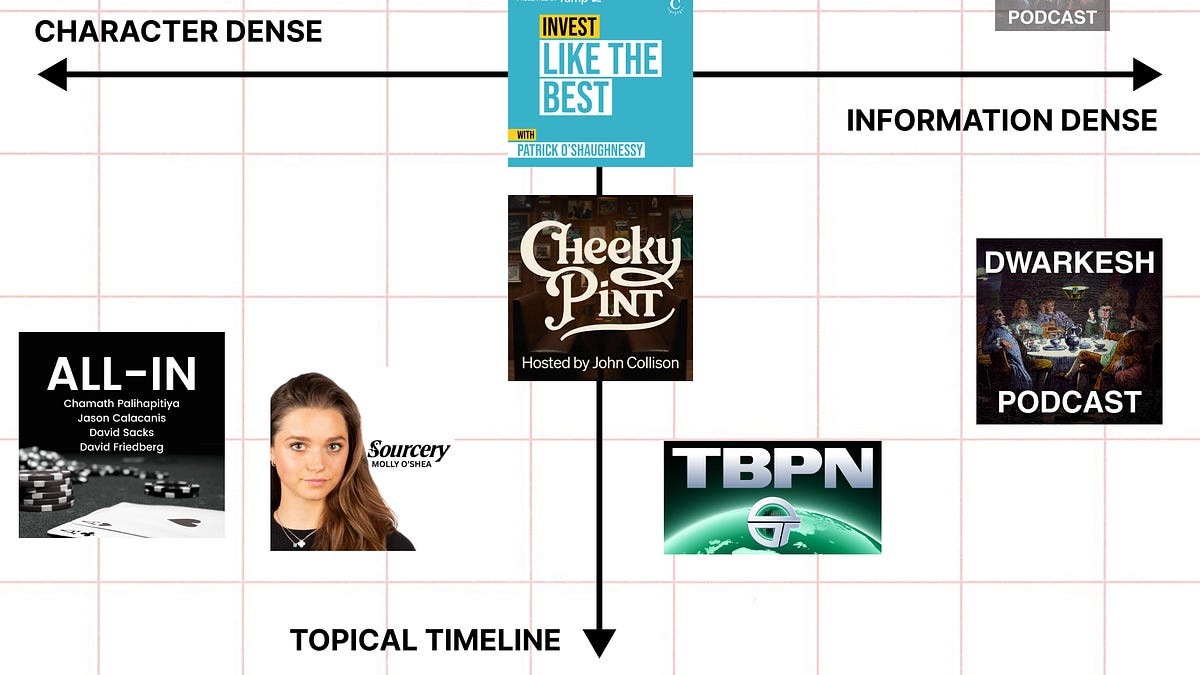
His tension between the evergreen library and the topical timeline is the best framing of podcast strategy I have read, and it collided with a matrix I had presented to a client in a loom. on the the other focus around “what territory does this show own?”.

Read his piece for the theory, whereas today’s piece is the operator's version - his axes describe what a show is, add these levers to decide how to do it.
The best question he asks is - what is this episode worth in 3 years?
In this asset class, catalogue value can go negative, which should impact your strategy.
Elsewhere. There is a genre of (several) big-fund podcast with 6 figures of YouTube views and 0 comments.


Strange. Even if 1M people had watched (allegedly), and not 1 of them had anything to say.
For a fund, that is not reach - view-maxing is a pointless endeavour for a firm that is not selling sponsorships. The audience you need to win in VC might be measured in 30 people.
If your show is true to its actual goals, success is dialogue - in the comments, in the replies, and then privately, in the DMs and the meetings the episodes generate.
The podcast that reaches the right 30, and gets them talking back, will in VC outperform the one with 100,000 silent views. Again Lever 1 is so important.
Lastly… not to discourage anyone who has read this far, but the levers are half the battle. The real wins are in the distribution setup around the show - where the episodes travel, and what they become when they get there. More on that another time.
Laurie, Refinery Media
If you made it all the way through, thanks so much for reading! a thousand VCs now open this every week. If it's helped you think differently about marketing, Venture, or storytelling, please send it to someone in your orbit.
If you enjoyed this, read more from our top posts: