- Refining VC
- Posts
- Three Charts That Explain VC Content Strategy
Three Charts That Explain VC Content Strategy
Ask These Questions Before Making Any Content

Laurie Owen
April 24, 2026
Before you open a content calendar, there are three questions worth answering.
What kind of content should you be making?
What format should it take?
And where should it actually live?
Most funds never ask all three… or ask them in the wrong order.
They start with where, pick a platform because everyone else is there, and produce something that feels appropriate for it.
Venture capital is underrepresented in most content marketing analysis. The frameworks tend to be built for SaaS companies or consumer brands, and the examples rarely translate (that’s the point of this newsletter).
But there are three charts, none of them invented for VC, that map almost onto the decisions funds face. Applied in the right order, they are more useful than most of the VC-specific content advice that exists.
👋 We’ve had a bunch of new subscribers join since the Murph Capital piece - welcome. If you missed it, you can catch up here.
1. What To Make
Kyle Poyar recently mapped five storytelling archetypes used by the best content brands in tech.
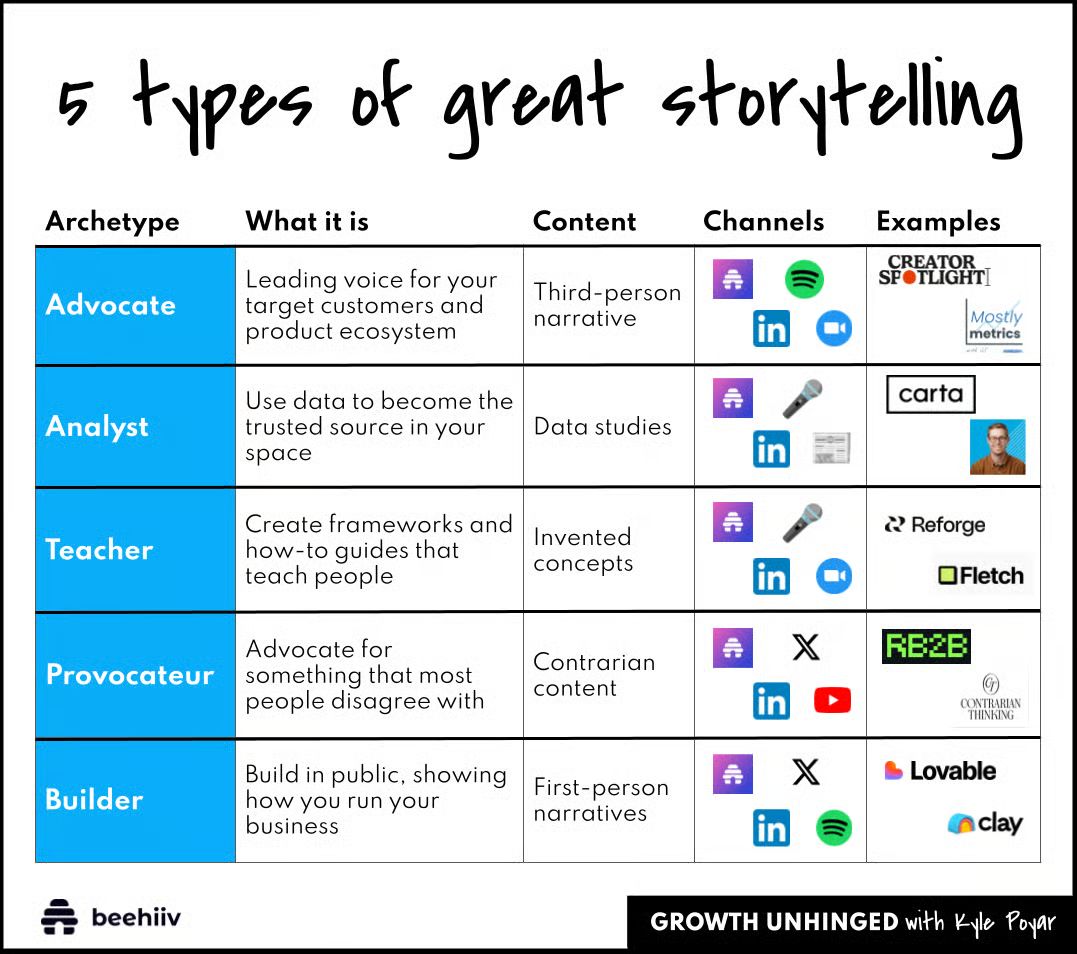
The framework is aimed at SaaS companies, but it translates directly.

Channel guide: [Substack icon] any long-form written. [Email icon] opted-in list outreach. [Slack icon] informal peer-to-peer. [X icon] individual personal account. [LinkedIn icon] firm or corporate account. [Podcast icon] any long-form audio. [YouTube icon] produced video - not a podcast long or short form.
The default assumption is that VC is saturated with Teacher and Analyst content. That's only partially true.
Teacher works when the expertise is first hand (from a GP) or expressed accessibly - YC and First Round built theirs over decades of proximity to founders, or format accessibility (Park Rangers Capital).
Yet many funds trying to be Teachers are sharing expertise that is broadly interesting rather than specifically useful.
Likewise, Analyst works when the data is proprietary. Rebel Fund (Jared Heyman) has built a distinctive reputation by producing rigorous, highly specific data around YC batches - content that is useful to anyone trying to understand/ access that market, and therefore excellent top-of-funnel for an LP base doing exactly that.
The insight is not just the data itself, it's that by consistently owning that specific angle, Rebel has become the reference point for a particular kind of investment.
Atomico did the same with State of European Tech - years of consistent tracking that now means when anyone wants to understand the European ecosystem, they go to Atomico first.
The Provocateur archetype is worth examining because it operates as a genuine barbell - two very different aesthetics producing similar results. Turner Novak at Banana Capital sits at one end: deeply embedded in VC culture through memes and irreverence, building top-of-funnel awareness, at the other end is Odin and Dan Gray - applying academic rigour and database-level analysis to whatever deal, fund, or hype cycle is dominating the news.
These look nothing alike. But both have achieved the same thing: a distinctive enough lens on the world that the audience knows what they're going to get before they open the piece. That recognition is the whole game.
The two most structurally underused archetypes are Advocate and Builder. Advocate because it requires community embeddedness - Solo Founders are doing this deliberately, building a community first - similar too Regionally focused funds (Credo) or sector specific funds (Supermoon).
The question is not which archetype looks most credible. It's which one you can sustain consistently enough that people start to expect it from you.
2. What Format
Alex Danco (ex-shopify, now editor at a16z) wrote a piece in 2019 applying Marshall McLuhan's hot versus cool media framework to audio.

It remains one of the sharpest pieces of media analysis I’ve read, but I rarely see it referenced.

The core distinction =
Hot media - high engagement, low participation.
Long essays, dense podcasts, long-form video They saturate the reader with information. You receive them.
Cool media - low engagement, high participation.
Memes, short images, group chats, DMs, punchy X posts They are incomplete by design, requiring the audience to fill in gaps using genre knowledge and cultural fluency. You co-create them.
The choice of format communicates something independent of whatever the content is about.
A fund publishing dense, information-saturated essays signals: we value intelligence and rigour vs. A fund communicating through memes and short-form signals: we value fluency and cultural fit.
Most funds have not made this choice consciously - there is a visible split between LinkedIn-native funds and X-native funds, which anecdotally also maps onto a geographic distinction between Europe and the US.
The AI wave makes this more distinct, imo. The current flood of AI-generated content is overwhelmingly hot - more essays, more long-form, cheaper and faster than before.
Whereas on X specifically, AI-generated content is instantly recognisable to anyone fluent in the platform. It lacks timing and the cultural specificity or in-group self-awareness that make something actually land in a community where everyone is watching everyone else.
Hot media can be faked at scale. Cool media mostly cannot.
Founders have understood this for a long time - building audiences on X to engage with VCs and make themselves more legible to capital. The cool media signals they send are shorthand for ‘hot deal’ signals at early stage.
I wrote about memes in VC - and the underlying point was the same: memes are a cool media format that signals being part of the “in crowd”.
Elsewhere, I think an opportunity that almost nobody in venture is exploring is audience participation in content… Formats that invite founders or operators to contribute, co-create, or complete the picture alongside you - are the coolest end of the spectrum and functionally absent from much VC content. That is a blue ocean.
3. Where To Put It
The Normie to Fringe chart (by Oren John) maps distribution channels across two axes: sales versus awareness, and mainstream versus fringe.

The Normie/Fringe axis is actually more interesting for VC than the original because the insight - that most funds cluster on the normie side while the best deal flow often comes from fringe-awareness.
i.e. the normie side of the chart gives you broad reach but shallow relationships. The fringe side gives you narrow reach but deep trust.

The more interesting question is what sits in the other quadrants.
Fringe-awareness is where many of the most interesting early founders live before they become legible to the market - specific communities or Discord servers around emerging technology. Funds that show up credibly in those spaces before they become mainstream build deal flow advantages that media presence cannot replicate. Partner personal accounts or build-in-public logs can also build these fringe-awareness plays.
Fringe-sales is the most underindexed quadrant for VC. This is where community-sourced origination lives. ODF, or Neo scholars are examples - the community is the sourcing mechanism, not a marketing outcome. Top of funnel marketing through interactive tools we’ve mentioned a lot fit here too, along with niche event hosting.
The “Normie to Fringe” lens also explains why cross-posting the same content everywhere rarely works. A piece optimised for LinkedIn - considered, mid-length, professional register - reads differently in a X community where that register signals that you do not understand the room. Distribution is a targeting decision and as mentioned above the channel choice encodes that decision whether you make it consciously or not.
The practical question is about the tension between depth and awareness.
A fund in active deployment needs deal flow, which comes from depth of community not breadth of awareness. An established fund trying to maintain brand position across a large LP base might genuinely need the normie-awareness quadrant.
Less is More
Three questions.
What archetype reflects your actual advantage?
What format signals the right thing to the right audience?
What quadrant serves your goal at this moment in the fund lifecycle?
The funds with the strongest content positions made fewer choices, not more. They picked an archetype that reflected something real, held to a format that signalled the right thing, and showed up consistently enough in the right places that the association eventually formed on its own.
Most content strategy conversations are about volume, variety, and reach. The more useful question is simpler: what is the one thing your content could become known for? Everything else follows from that.
Laurie, Refinery Media
If you made it all the way through, thanks so much for reading! Several hundred VCs now open this every week. If it’s helped you think differently about marketing, Venture, or storytelling, please send it to someone in your orbit.
If you enjoyed this read more from our top posts: