- Refining VC
- Posts
- How To Make VC Content Original
How To Make VC Content Original
Why an entire industry ended up telling the same story, and a practical framework for being different

Laurie Owen
March 11, 2026
One generation of funds built blogs. The next discovered podcasts. The next figures out Substack.
Ecclesiastes puts it more poetically - “The wind blows south, turns north, returns again to its circuits... There is no new thing under the sun.”
Venture media can feel a lot like that, platforms change, but the content rarely does.
A while back I wrote about why all VC content feels the same. It's one of my most read pieces, probably because it’s true…
The response I get is some version of: "You're right. So which platform should we try next?"
This question assumes the problem is platform.
But I also poised a question in my a16z media breakdown I keep circling…
What does a16z wish they'd started 5 years ago?
Because whatever they're building NOW (Erik Torenberg acquisition, David Booth ecosystem hire, community infrastructure) is what will be table stakes in 2030.
Which means the real opportunity is finding what's NOT obvious yet. Success is always a lagging indicator…
The formats that look obvious today looked strange years ago, and the firms that adopted them early built advantages that are almost impossible to replicate later.
So this piece goes a step further than the original diagnosis.
Not just why VC content feels the same.
But where are there real gaps… and what kind of thinking helps you spot them before everyone else does.
The Map
Before we can talk about where the gaps are, it helps to have a shared picture of the territory.
Media formats are some combination of three basic primitives: written ideas, visual storytelling, and conversation.
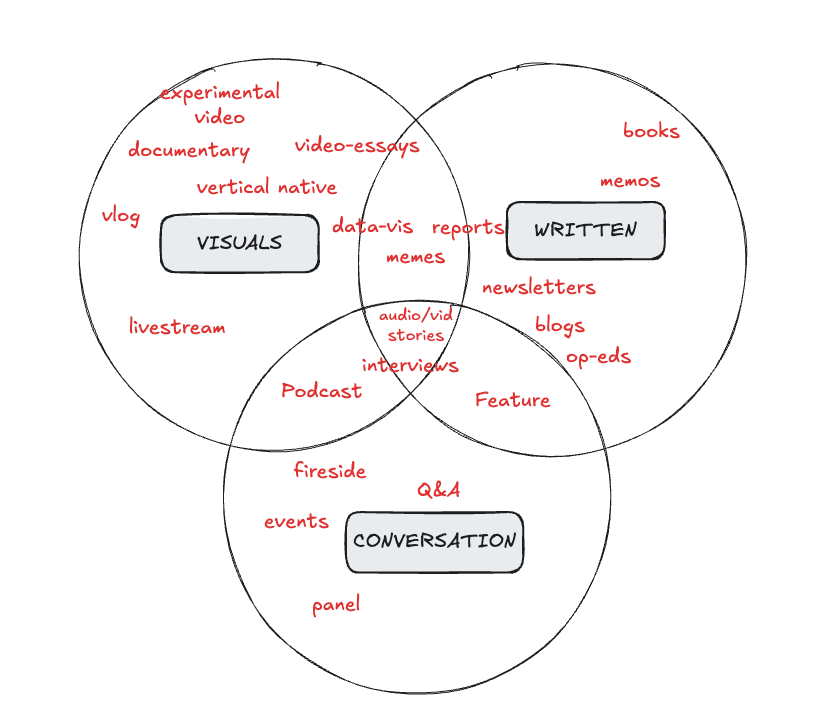
Everything else (imo) is a combination of those three. Traditional formats typically sit in their own circle, with most modern formats somewhere towards the overlaps.
Now add a second dimension: tempo. Every piece of content also sits somewhere on a spectrum from long to short.
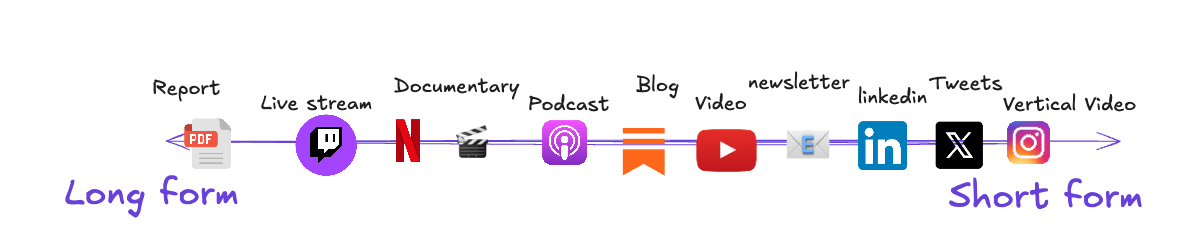
Platforms are really selecting for this tempo too, via what they reward.
This mapping shows you what's structurally possible before you start asking what's strategically possible.
So, now plot VC media on that map…
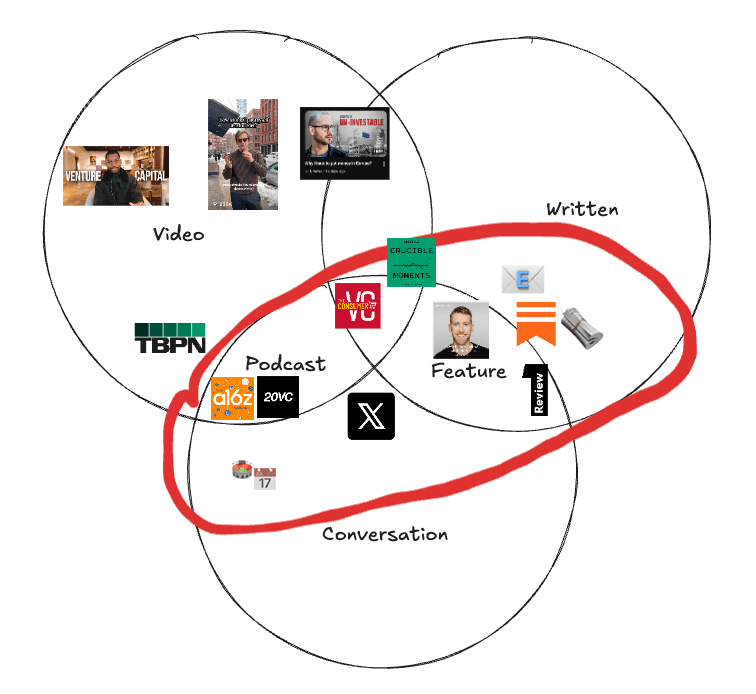
Almost everything clusters in the same intersection. Conversation formats - podcasts, interviews, panels - occasionally hybridised with written summaries or clips.
Call it the VC content trap… conversation + commentary, repeated across every platform, every fund size, every geography. The red circle is 95% of the industry.
There are outliers. But the clustering is clear, ironic even, given that the industry producing this content prides itself on non-consensus thinking.
When a launch works, the industry reverse engineers it. Threads get copied almost word for word. Visual styles get replicated. The same pacing, the same structure, the same framing.
You saw this recently with the wave of techno-accelerationist style launch videos. What started as frontier content quickly became cliché.
The moment something works, everyone races toward it. And once everyone is there, the advantage disappears.
When that happens, the industry tends to collapse back to the default safe and median content style…
For example, below, four different funds competing in the same market (!). Different brands, but near identical outputs…. Swap the logos, the viewer might not even notice.
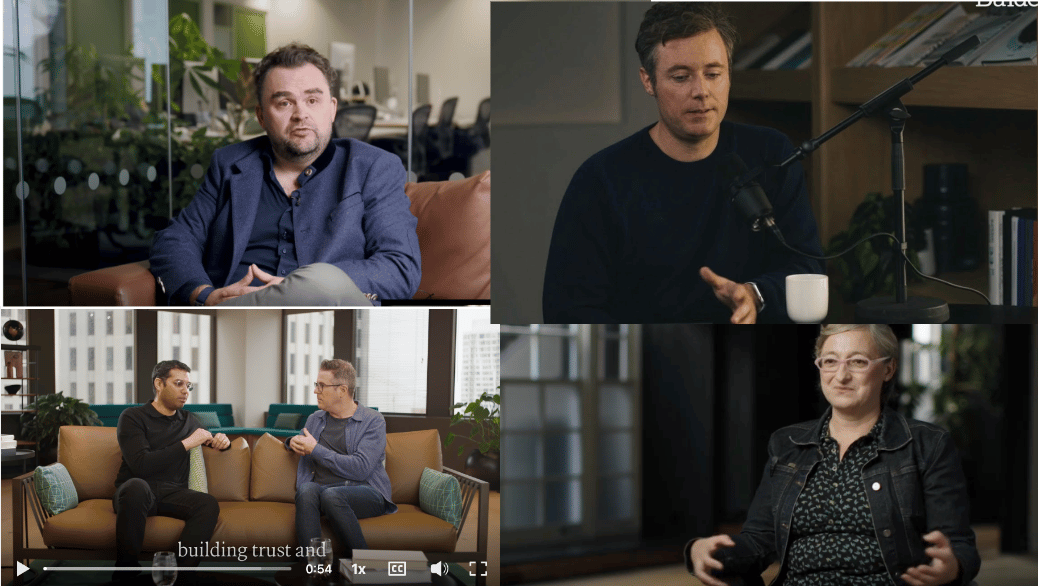
4 competing funds, within the last month.
When funds try to break out of the above trap, they almost always move along the distribution axis. Start a newsletter. Start a YouTube channel. Try TikTok. Get on Instagram. But the content inside those new containers doesn't change. Just with different lighting or a slightly younger person running the account…
Which means the real blue ocean isn't a platform.
So, what’s the space outside that red circle?… There are actually two levels to it.
Level 1: The Format Variable
The first layer is the simpler one, and it's already starting to be discovered.
There are formats that are proven in adjacent spaces - in creator media, in journalism, in entertainment - that have barely been applied to venture. There is opportunity in being among the first to bring it across.
Creator-style video is the most obvious example.
Andreas Klinger is building a YouTube presence documenting founders, Gabriel Jarrosson is doing the same for Video essays.
Marshall Sandman is posting solid numbers on Instagram with VC content that looks and feels nothing like what funds produce.
Brandon Bryant has just started to vlog.
None are doing anything structurally radical - just applying formats that work everywhere else to a VC context where almost nobody else is doing it.
TBPN (and etn 🇪🇺) is another obvious version of this. Live market commentary has existed in financial/sports media for decades - they imported it into venture.
These gaps will appear over time too… the “whiteboard video” is a current example. In the creator and info-product space, whiteboard-explainer videos - are currently one of the highest-performing formats. Enormous conversion rates, deeply effective at turning a viewer into a believer in whatever the person is teaching.
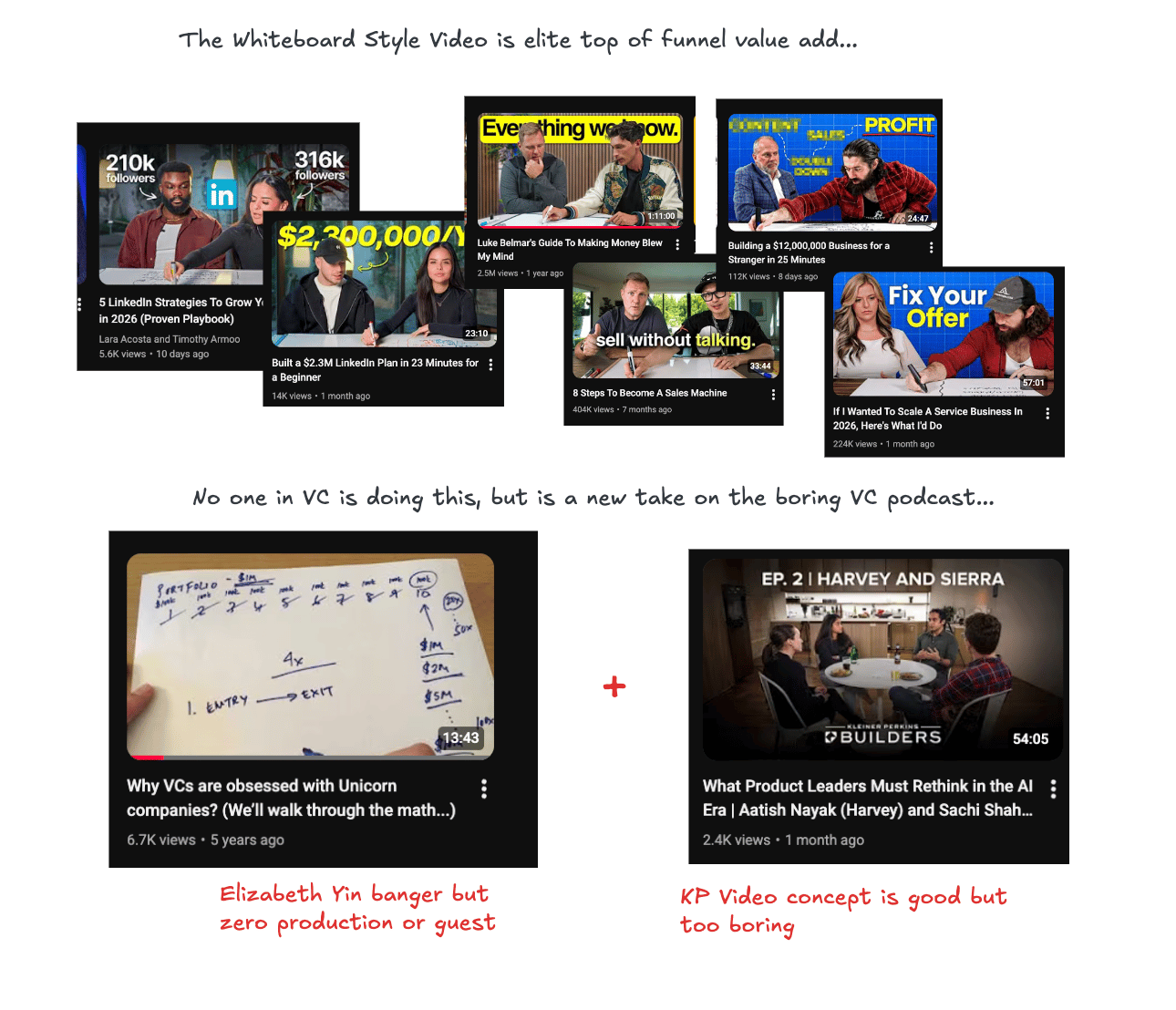
Ironically, whiteboarding is completely native to startup culture but this content hasn’t surfaced in the VC space.
Likewise, true documentary is the same gap. Replit just released a film documenting building their product - super raw and cinematic - i’d encourage you to watch it. Nobody in venture has done the equivalent - the raw material is extraordinary, yet the format is sitting there completely unused1
Most of the left side of the format spectrum is unoccupied in venture. The short-form video space, despite years of funds saying they need to "figure out TikTok," remains largely tokenistic. Even regional formats are almost entirely absent: specific, non-English-language content.
But this first layer is only about finding a less crowded surface. Important and worth doing… but still not the deepest insight available.
1 yesterday Benyam Emphrem, launched Silicon Valley Film Fund, some excellent story ideas in this article
Level 2: The Narrative Variable
Within the formats that do exist in VC, and even within the formats that are starting to emerge at Level 1, almost everyone is using the same three narrative structures.
Interview. Advice. Hot take.
That's been the entire structural map of venture media for a decade, across every platform, every format, every fund size. New platforms/formats get tried. But the narrative structure inside the content almost never changes.
Dominant VC podcast model = a GP and a founder, talking through a topic or a company journey. It's fine, sometimes useful. But you could swap the host, the guest, the fund, and nothing changes about what the listener experiences.
This is the variable firms aren't changing - what kind of narrative container it sits inside. What relationship the reader or viewer has to the content as they move through it - are they receiving conclusions, watching a process, following a mystery, entering a world?
Every other creative industry treats narrative structure as the primary lever.
Journalism has investigations, profiles, criticism, oral histories, first-person essays, explainers, reconstructions.
Documentary film has dozens of structural forms - the observational doc, the essay film, the archive-based reconstruction, the participatory format where the filmmaker becomes part of the story.
Even podcasts outside venture have fractured into genuine subgenres - serialised investigation (Serial), narrative nonfiction (Radiolab), immersive audio drama, the real-time diary.
Venture is still doing the interview. In 2026.
Written VC content is no different. The format that dominates is inward-looking opinion - analytical essay, thesis post, investment memos.
The structures that barely exist are the ones that require something different from the writer.
Below are hypothetical examples that might add some colour to this point -
The oral history - multiple voices reconstructing a single moment or period.
The investigation - an unresolved question, reported, without a tidy answer at the end.
The profile that spends time with someone rather than asking them to narrate their own success (tbf Indie VC does this nicely).
The annotated internal document - e.g. a memo we wrote, here is what we were thinking, here is where we were wrong etc.
Almost none of this exists in venture content. Perhaps, the reason is that it requires the writer to to give something up - certainty, or the position of the expert commentator.
Breaking The Frame
Some firms are, to their credit, looking to break the frame -
One new example I am curious to follow is Nebular, a deep tech fund, launched a podcast called 2050 framed around founders building for what the world looks like thirty years from now.
The temporal structure is has potential to be v different. The conversation is anchored in a future moment and works backward, which changes everything about what gets discussed/asked, and how it feels to listen. Solid structural innovation.
Likewise, Sequel, is rebuilding built their entire content identity around the idea that fiction predicts the future. The premise is that C3PO and VR etc all lived in stories decades before they lived in reality - therefore, the fiction being written right now is a map of where technology is going. This strange enough to be memorable, and Sequel's brand will grow inseparable from that frame.
Livestreaming also has some low hanging fruit, I am following Brycent and Vesting TV - live startup pitching, and building an audience around streaming startup content. I’m bullish here, within 5 years he’ll probably have a fund.
The Pitch Fund went further still - an A+ media property built around live pitching that then became a $10M investment vehicle itself. It's not content that markets a fund - the content is the fund. That inversion is about as structurally radical as VC media has got.
Where To Start?
Often firms audit their content by asking how it looks and sounds - so they only upgrade production values - better mics, nicer studio, video editor etc. Optimisations of the same container, not changes to what the container holds.
Few think about the structure underneath all of those choices, because nobody has told them it's a choice. Here's how to rethink it:
1. Audit what you have.
List your last ten pieces of content. Write down the format - written, video, conversation - and the narrative structure - interview, analysis, hot take, or something else. If they all look the same, you know what you're working with.
2. Find the gap.
Are there whole formats you haven't touched - video, reports, documentary? If yes, that's the most obvious place to start. If you're already across formats and everything still feels the same, the gap is likely what's inside it.
Worth noting - the people doing this most effectively usually had a foundation already in place. Coogan had 100k YouTube subscribers before TBPN. Brandon Bryant had 100k on Instagram. The unconventional landed better with an already familiar audience, that doesn't mean you need 100k followers to do something different - just know that the conventional work and the experimental move tend to be sequential.
3. Pick one experiment. Not a rebrand or a full series yet. One piece, one new structure, see what happens. Write your next essay set in 2035 as if you're looking back - future history forces specificity. Pick one unresolved question in your market and report it without answering it at the top or next time you visit a portfolio company, document what you see rather than replicating the PR report - write it like a POV journalist vs. an investor.
4. Measure the right thing. Don't measure views on the first attempt. Measure whether people responded differently - fwd it, referenced it, brought it up in a meeting. That's a stronger signal that the structure is working.
All this matters beyond views and follower counts.
Founders choose investors partly on fit - the vibe, the “taste” of the people around the table. And increasingly, content is how that signal travels, a founder encountering your content is deciding whether you're their people.
Which is why the firms doing something genuinely different - whose content makes you feel something rather than just inform you - have an advantage that compounds.
This is good news for smaller funds. You don't need mass appeal. You need the right twenty founders a year to think that's the kind of investor I want. An opinionated, distinctive content identity does that better than a polished, broadly appealing one ever could.
Laurie, Refinery Media
If you made it all the way through, thanks so much for reading! A few hundred VCs now open this every week. If it’s helped you think differently about marketing, Venture, or storytelling, please send it to someone in your orbit.
If you enjoyed this, read more from our top posts: