- Refining VC
- Posts
- Another VC Tool Just Launched.
Another VC Tool Just Launched.
What the vibe coding moment means for VC marketing - and how to avoid the graveyard

Laurie Owen
March 26, 2026
6 months ago I wrote a piece called The Future of VC Marketing is Interactive. The argument was funds investing in software companies were failing to use software themselves as a marketing tool.
Many of these examples are novel and have stood the test of time. For example, YC's co-founder matching has produced >25 YC backed companies.
However, a lot has changed, that piece came out before Opus 4.5 (we’re now on 4.6).
This week was the Data Driven VC conference. Lots of great discussion about what funds are building internally with AI - agents replacing analysts, internal deal flow tooling, portfolio monitoring. The internal transformation story is well underway.
But there is still little conversation about the external opportunity. What AI-native building means for how funds show up to founders or LPs.
And while I'm seeing every day on the timeline - another VC, another vibe-coded tool, the lesson from podcasting is that shipping was never the hard part. 80% of podcasts never get past 3 episodes - get to 20, you’re in the top 1%.
Distribution, consistency, and finding an audience is where 99% failed.
If the graveyard of abandoned podcasts is enormous, the graveyard of abandoned VC tools is about to get very full, very fast. The question is what to do about it…
Why passive content is losing
AI has made written and video content cheaper to produce at scale. This meant the volume of passive content - blog posts, LinkedIn takes, newsletters - has gone through the roof.
While luckily this does also make it easier for A+ content to stand, there is still a collapsing signal-to-noise ratio.
Interactive tools cut through that in ways passive content increasingly cannot.
Posts that have an interactive element consistently get more engagement than static ones, and tools can create built-in funnel mechanics - email capture, return visits, data generation - that even well-written essays cannot replicate.
This is the "why now" argument. The category was always interesting, but the noise floor for everything else going up makes the relative advantage of tools larger, not smaller.
Even at the most basic level, the gap between static and interactive content is visible.
Compare a static market map - to a fully interactive one where you can filter, find out more, connect with teams etc. Same thing - different experience (+ minimal effort).
FOV Ventures did this with their robotics market map and the engagement difference is significant. Ignore any impression count - I was at FOV’s event yesterday where >10% of participants signed up via the market map (imo event attendance is the number 1 predictor of content engagement).
Ultimately, it is just so easy for marketing teams to test ideas like this quickly and cheaply, and they probably should be doing it routinely.
To prove the point in the ~30 minutes to draft this piece I built a simple Refinery Media newsletter library - a page where you can describe what you're struggling with on VC content and it surfaces relevant sections in pieces about that topic.
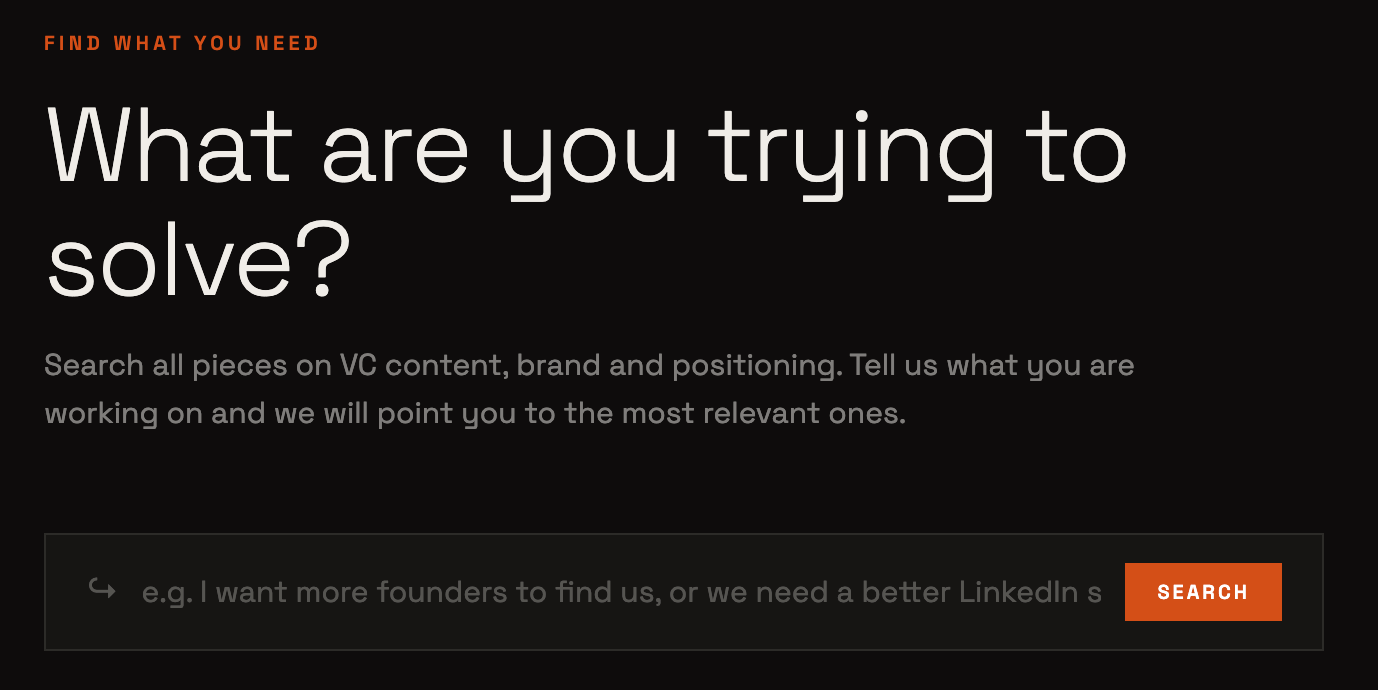
A few mins later, voila, https://reading.refinerymedia.co.uk/, another for the grave
From product to media asset (avoid the grave)
But as the barrier to building drops, the graveyard fills. This is the podcasting parallel playing out.
The pitch deck review tool has become the lowest common denominator of the category - an obvious first move, the “podcasting-is-easy” of VC tools.
It requires minimal thinking about audience, minimal investment in distribution, and produces a known output. Several funds have launched versions in the last few months.
Most slung it up as a Twitter link. The tool is useful once, for a founder in the middle of a specific task, and then it's done.
Elizabeth Yin from Hustle Fund launched Dunkey AI this week - an AI tool designed to speed up the process of creating a compelling pitch. With a couple of attempts it was quite easy to give it a bad pitch and still pass…
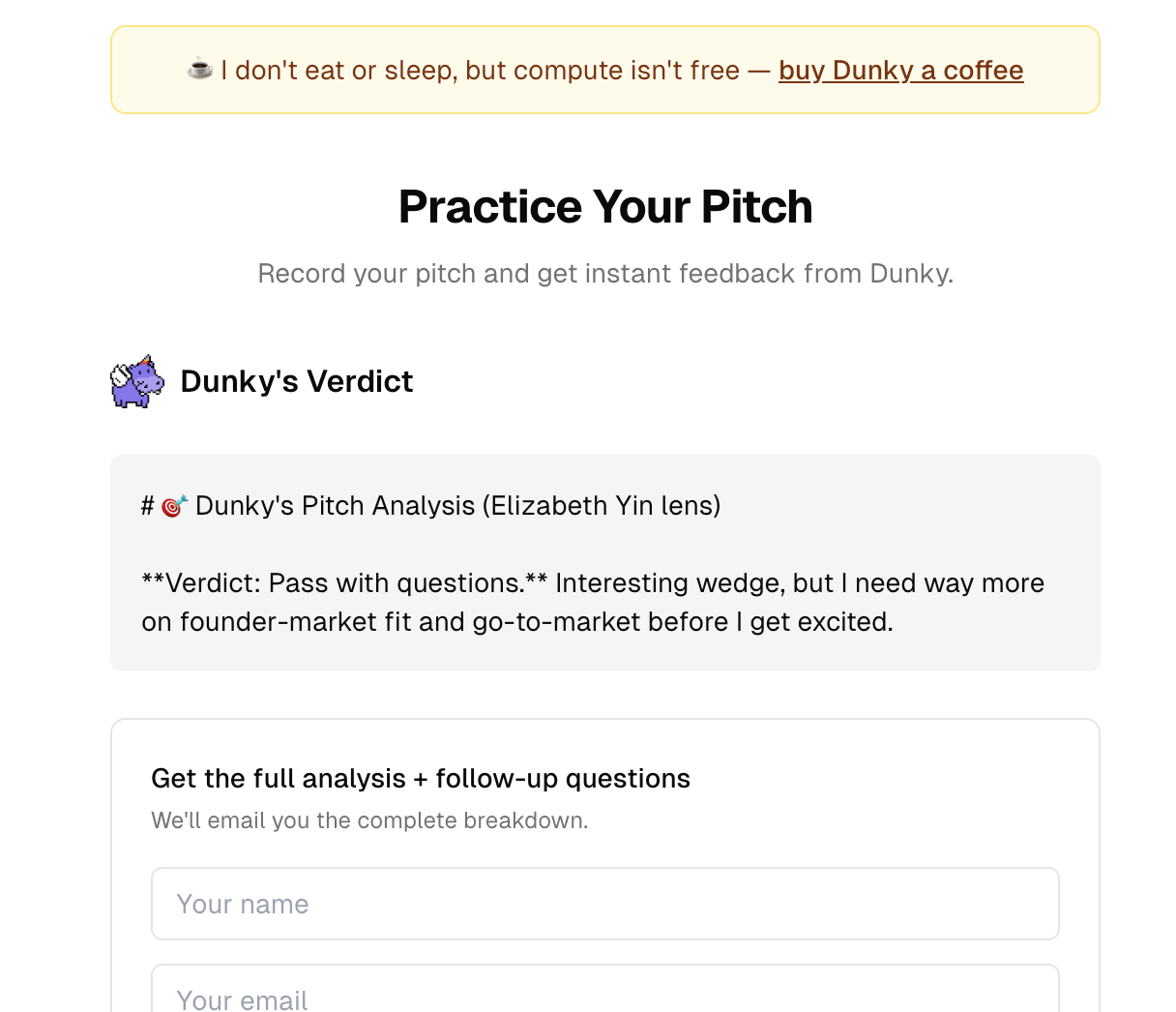
My Bring Back Pet Rocks because of Nostalgia and Anti-AI trend was a Pass!? Sweet.
It feels less like a serious tool and more like a top-of-funnel mechanism for their founder newsletter - which, to be clear, is genuinely excellent content and one of the better things in the space. If that's the explicit goal, fine. Using a lightweight tool to capture emails for wider content is a legitimate play. Just don't mistake it for a tool strategy.
Ada Ventures took the same category a rung further — paired their pitch deck tool with a PR push, which at least treats the launch as a media moment rather than a tweet. Better… Still not the flywheel.
The funds getting lasting value from tools are treating them as media assets, beyond just shippable products. The distinction matters more than it might seem.
A product you ship gets launched, posted about, and (often) forgotten.
A media asset gets launched with a narrative, fuels ongoing content, generates data that becomes future content, and creates a reason for people to keep coming back.
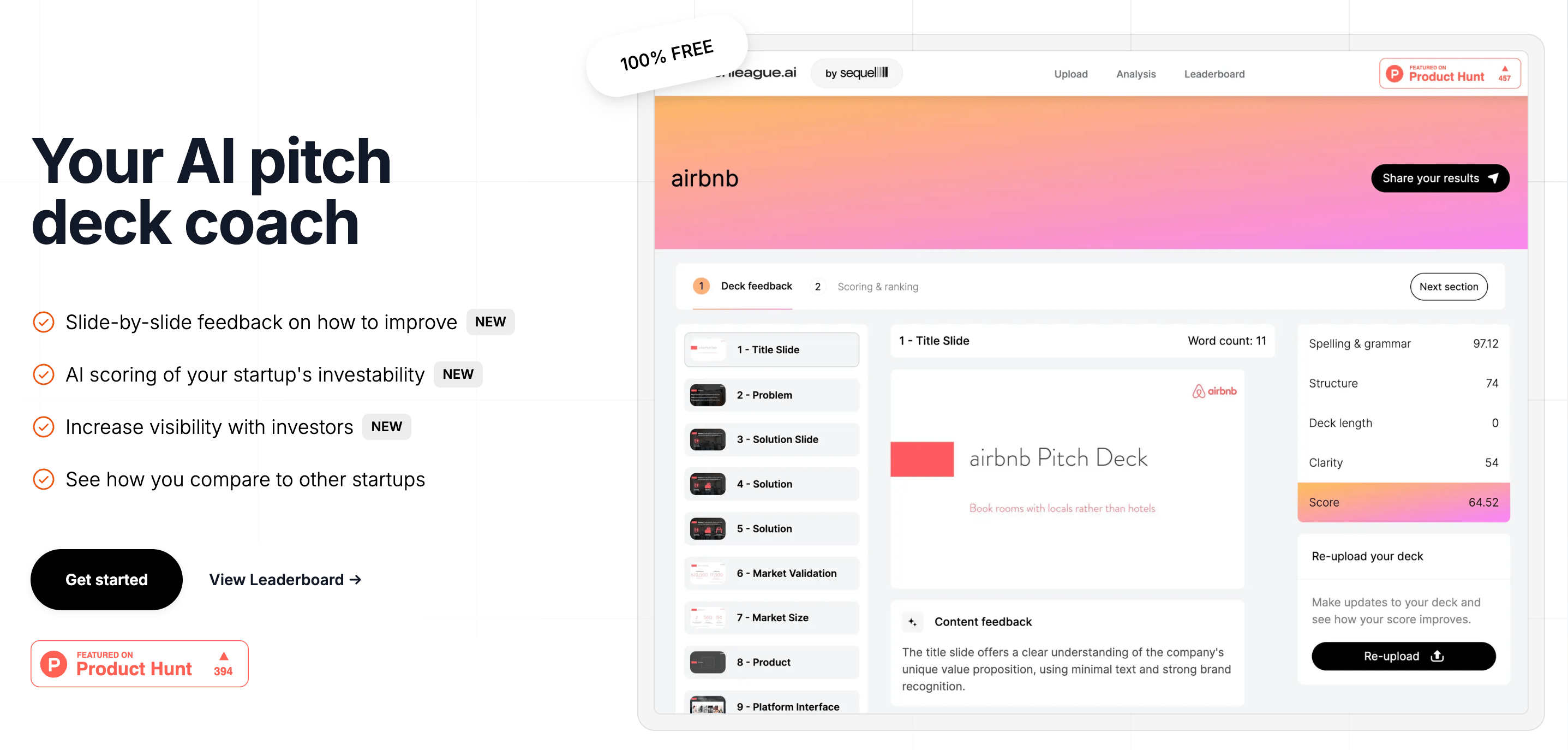
Sequel’s Pitch League is a great case study for this.
They launched on Product Hunt with a social campaign and ranked in the top products of the day. But that was just the start.
They turned the tool into The Founder Files: a 50+ page analysis of over 17,500 pitch decks and funding outcomes. From there came multiple posts, video content, talking heads, PR etc etc.
 | 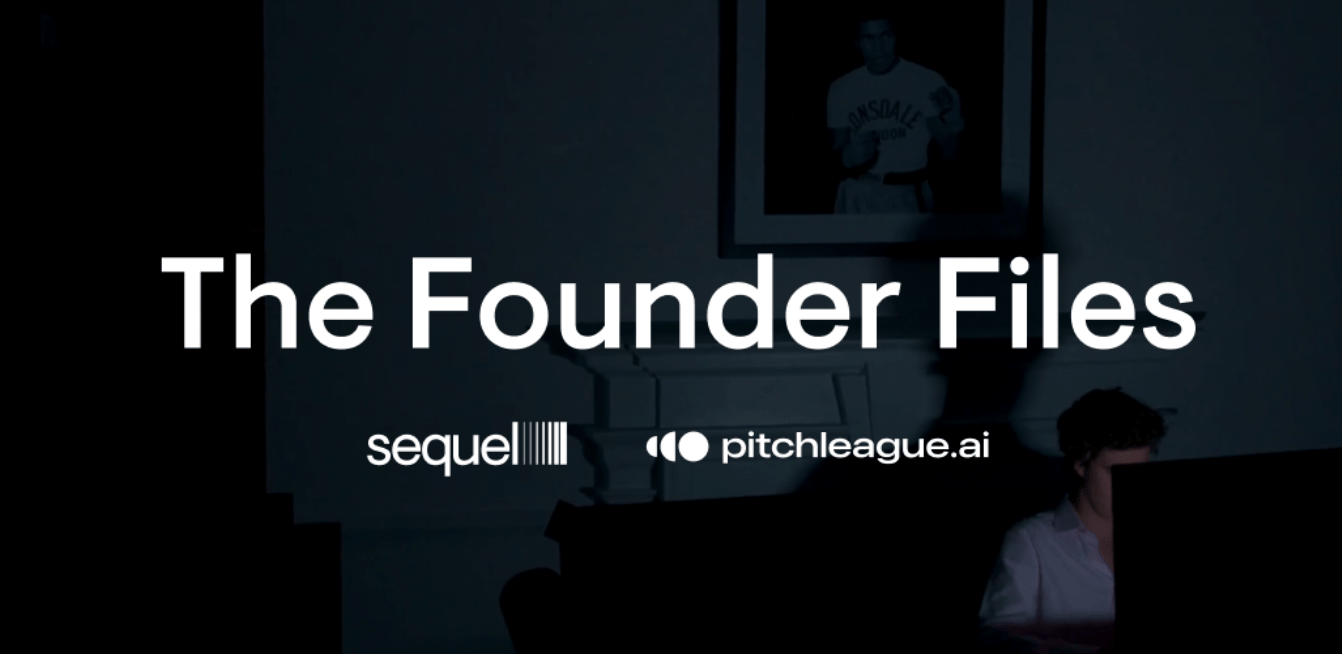 |
They even hired an intern and documented his journey parsing the data! (vid on that below)
The tool then became a content engine - and for their hybrid fund and SPV membership model, that data is part of many LP memos to their members. That is a fundamentally different relationship with a tool than launching it and moving on.
I look forward to their second year of the report this year.
Another example is Headline. Who last month launched GitVelocity - an AI tool that scores engineering output per pull request, built originally for their own portfolio and now released publicly.

Their CTO Conrad Chu was just at webinar talking about it, Headline had a recent post Anthropic's AI fluency index which referenced the tool.
The tool is clearly aimed at technical builders - which maps directly onto who Headline wants in their deal flow. The data it generates will become benchmarks, which will become posts, which will bring engineers back to the tool. The flywheel is visible from the beginning because they designed it that way.
It is also worth noting that tools do not have to target founders…
Trace Cohen built valueaddvc.com - a suite including a Fund Tracker and Unicorn Tracker, tools that track things like ArfurRock's X predictions and the Ontario Teachers' Pension Plan investments.
Trace invests out of a family office, so his real audience is VCs and LPs rather than founders. He is using tools to build value for the audience that matters to him.
The framework before you build
3 questions worth asking before writing a line of code.
Anchor to enduring problems
The tools that compound are anchored to problems that recur across the company lifecycle. NFX Signal is useful every time a founder raises. Index OptionPlan is useful every time a founder hires. A pitch deck tool is useful ~once. Recurring problems create returning users. Returning users create compounding brand.
Note, while NFX signal is the OG, I recently saw David Kaye from F4 Fund launched F4 Raise - a platform for startups to apply, and match with VC firms. 204 startups applied in 4 days.
Build the tool, then mine it for content
Sequel's pitch deck tool generated 17,500 data points. That is a research paper, a series of posts, a hiring narrative, an LP memo, a reason to cite Sequel when there’s talk about fundraising. The tool produced an ongoing content advantage. If you cannot answer what the tool generates beyond the tool itself, it is not a marketing asset.
Treat launch as a media event
What is the distribution plan before you ship? Who is going to see this? Why would they share it? What companion content explains the methodology? What recurring cycle can you tie it to?
The advantage is still available
Tools are still novel enough in VC that building something simple + useful gets disproportionate attention. That window is not going to stay open much longer.
But marketing is disproportionately important - note, Garry Tan has been everywhere with GStack - referencing it constantly, squeezing every last bit of distribution out of it, making it feel like the most important thing in the YC ecosystem right now…
Yet the tool itself is basically a collection of markdown files. Say what you will, but it has 50k GitHub stars. That is a masterclass in marketing the tool regardless.
While there is a lot of exciting stuff happening internally - USV published a great piece yesterday on how they are using AI agents inside the firm - the funds that build lasting brand advantages here will treat every tools as part of a content strategy.
However… The work begins after you ship. It always has.
Laurie, Refinery Media
If you made it all the way through, thanks so much for reading! Several hundred VCs now open this every week. If it’s helped you think differently about marketing, Venture, or storytelling, please send it to someone in your orbit.
If you enjoyed this, read more from our top posts: